Summary : Where does Antigravity look for configurations?

Antigravity Configuration Summary

💡 This post is the concluding summary of a series on Antigravity configuration:

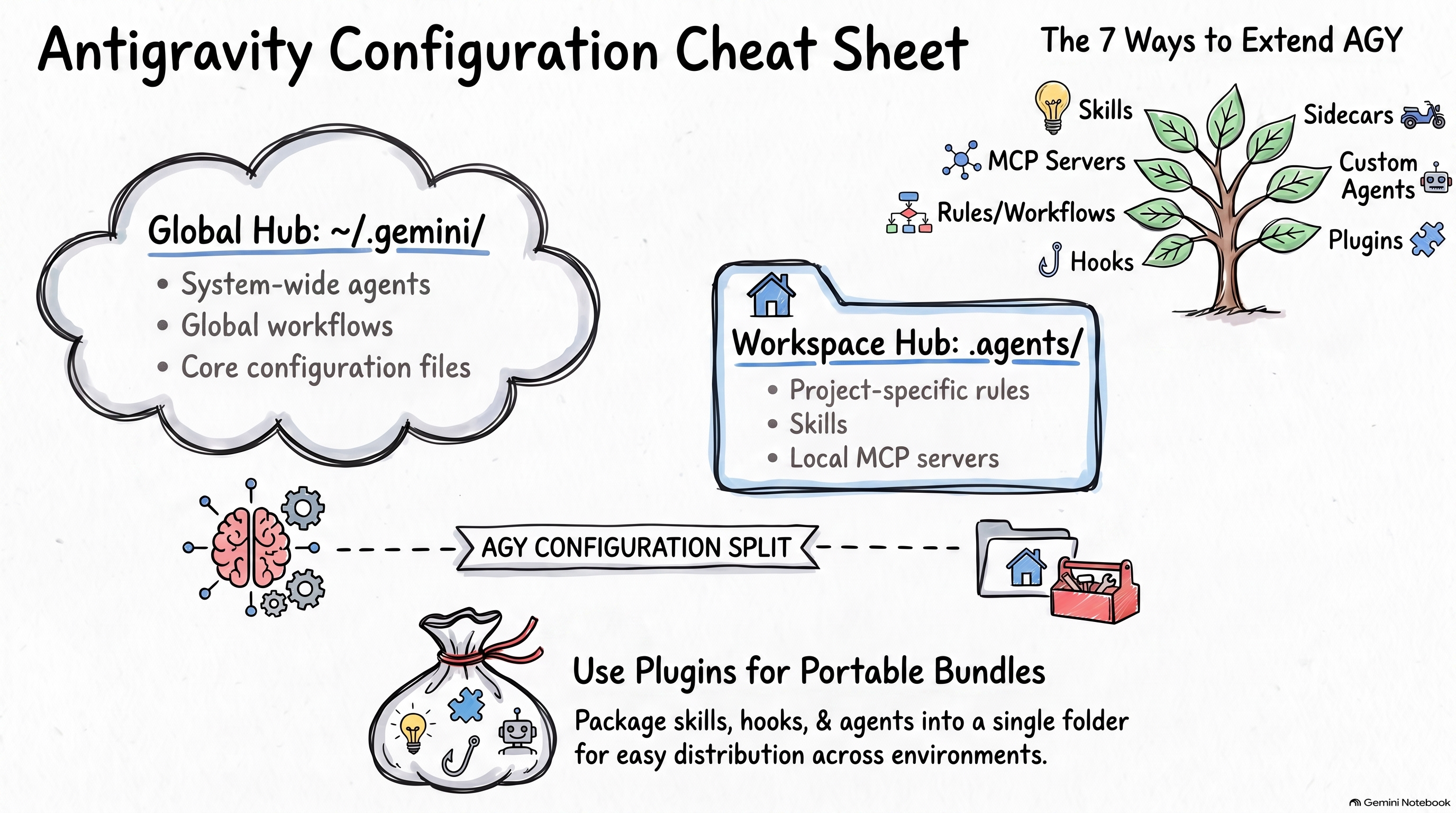
Over the past few weeks, I explored the ways to configure and extend Google Antigravity (AGY). What started as a simple exploration into agent skills quickly grew into a journey uncovering MCP servers, rules, workflows, lifecycle hooks, background sidecars, custom agents, and plugins.

Read More →

Where does Antigravity look for Agents?

Antigravity Agents
Antigravity Agents

â„šī¸ Note

This post blog is part of a series, see Summary : Where does Antigravity look for configurations?

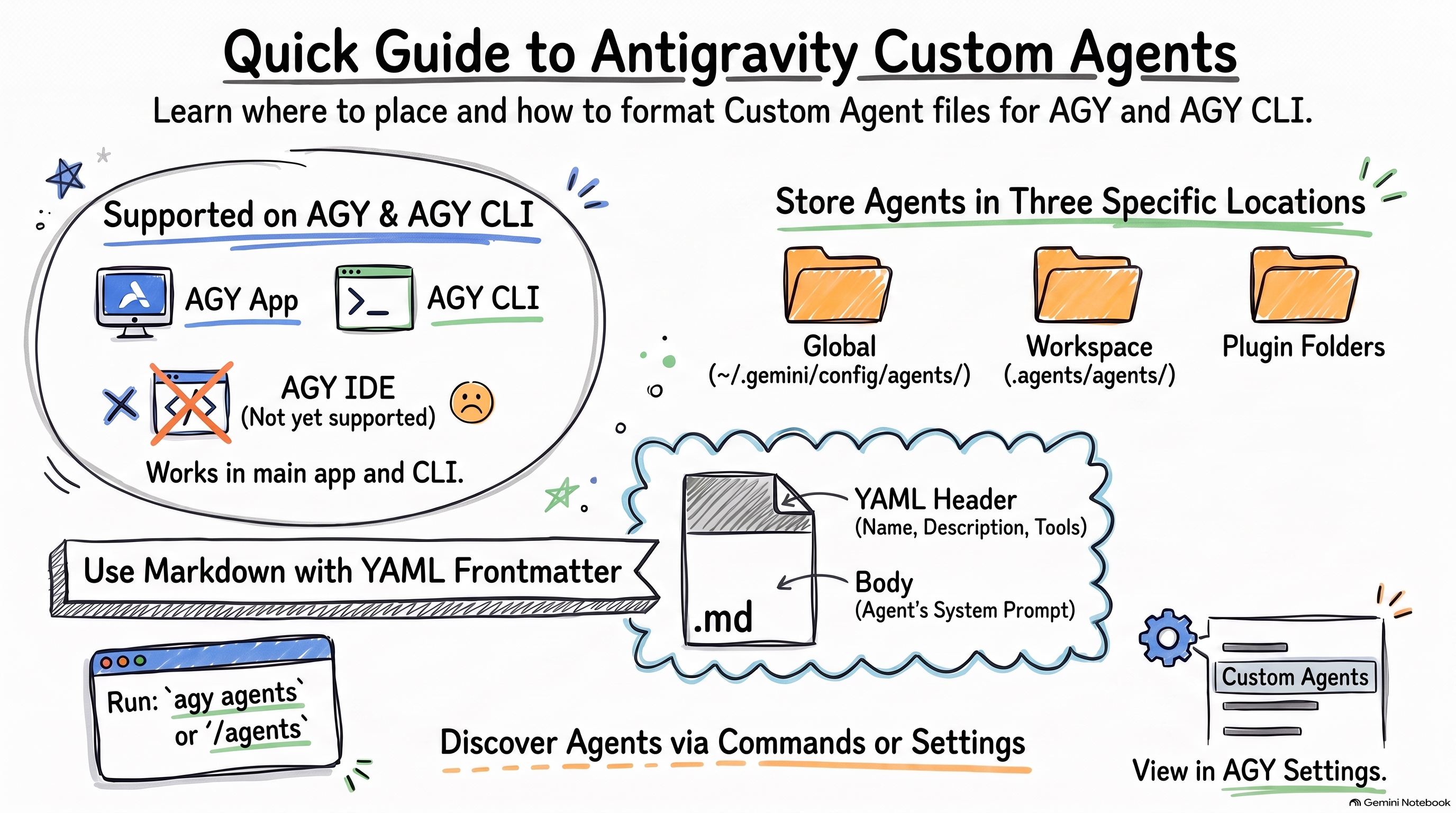
Custom Agents have been recently announced in Antigravity (AGY). In today’s post, I’ll explore how to configure and use Custom Agents.

Custom Agents

Custom Agents in AGY are a way to create customized agents that can be used as main or sub-agents. This can be useful to limit the agent to a particular role with its specialized instructions, tools, and constraints. Currently, custom agents are only supported in AGY and AGY CLI, but not in AGY IDE.

Read More →

Where does Antigravity look for Plugins?

Antigravity Plugins
Antigravity Plugins

â„šī¸ Note

This post blog is part of a series, see Summary : Where does Antigravity look for configurations?

I’ve been exploring how to configure and extend Antigravity (AGY).

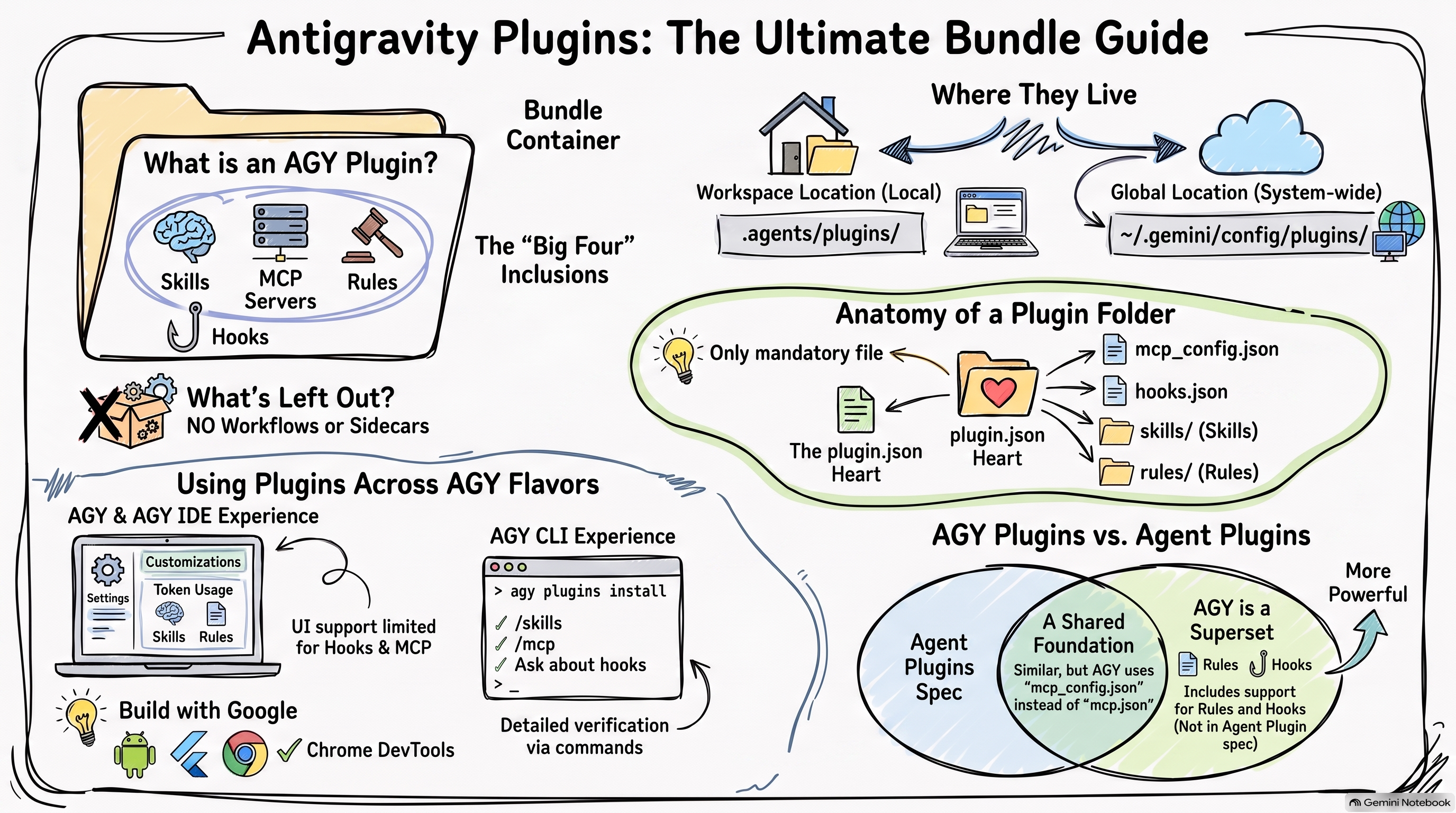
In today’s post, I’ll explore Plugins, yet another way of configuring AGY. We’ll also explore Build with Google plugins and the differences between AGY plugins and Agent plugins.

Plugins

Plugins in AGY are a way to package and group **Agents, Skills, MCP Servers, Rules, and Hooks together. This can be useful when you want to distribute and install a collection of these configuration options in one go. It’s also another way of configuring and extending AGY.

Read More →

Where does Antigravity look for Sidecars?

Antigravity Sidecars

â„šī¸ Note

This post blog is part of a series, see Summary : Where does Antigravity look for configurations?

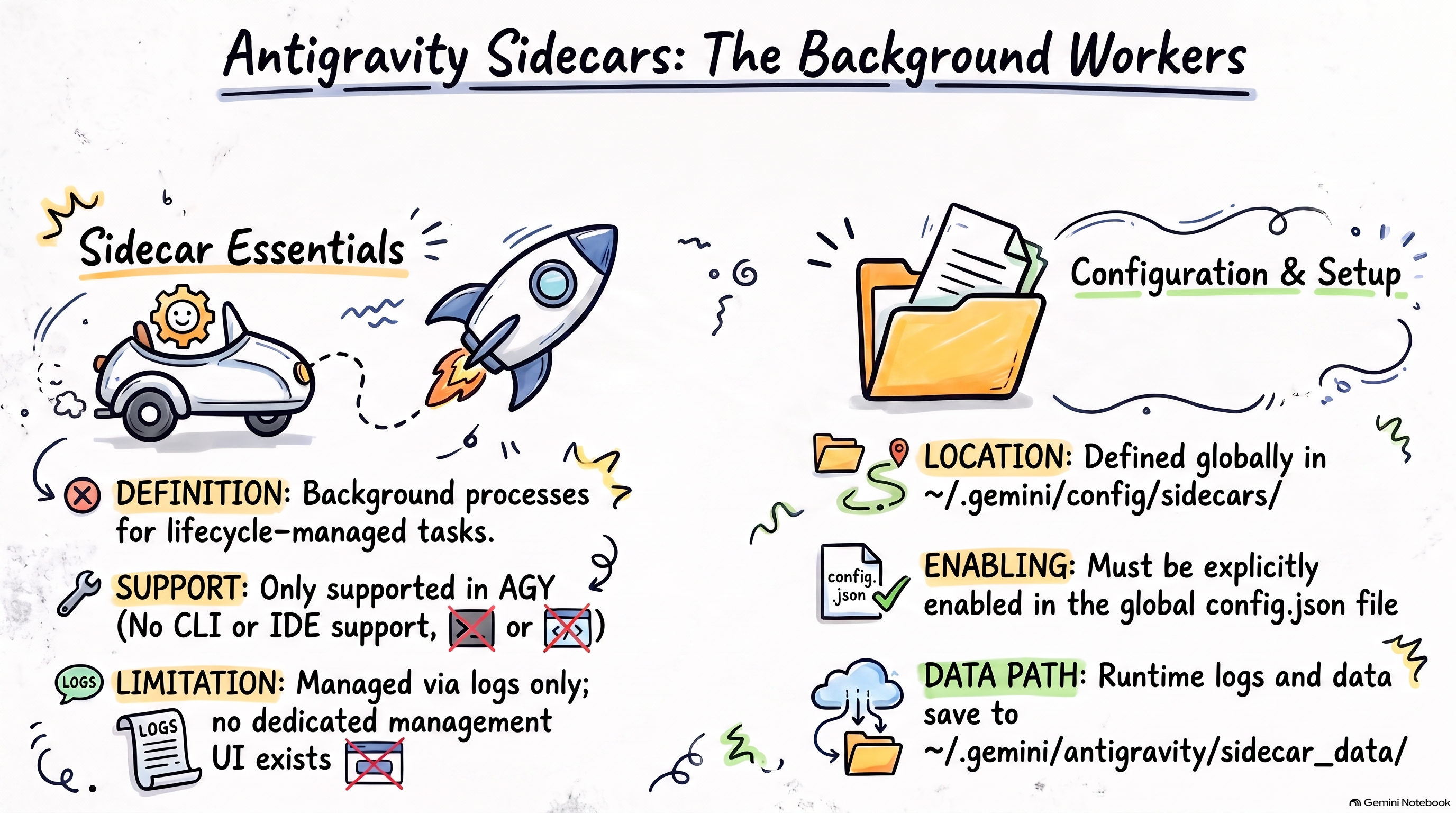
Sidecars are a less known feature of Antigravity (AGY) with limited samples and documentation but still worth knowing about and that’s the topic of today’s post.

Sidecars

Sidecars are background processes that can run alongside AGY with their lifecycle managed by AGY. They can be useful to run background scripts (e.g. sending telemetry data) or recurring tasks that you want to run on a schedule (e.g. summarize across sessions).

Read More →

Where does Antigravity look for Hooks?

Antigravity Hooks
Antigravity Hooks

â„šī¸ Note

This post blog is part of a series, see Summary : Where does Antigravity look for configurations?

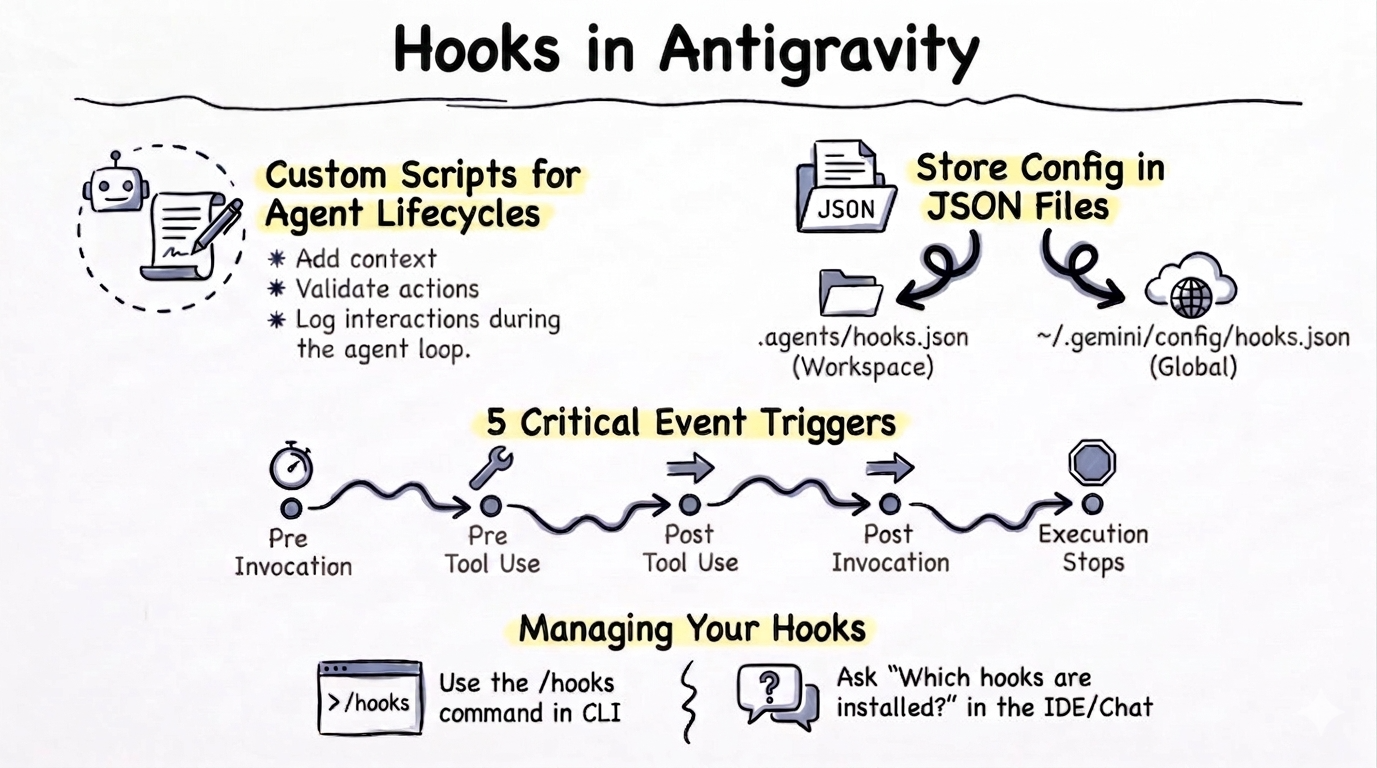
In today’s post, I’ll talk about Hooks in Antigravity, what they are, how to configure them, and some shortcomings.

Hooks

Hooks allow you to run custom scripts or programs at specific points in the Antigravity agent lifecycle, such as before or after model or tool calls. They are a way to extend the functionality of the agent. Hooks run synchronously as part of the agent loop and they can be useful for things like adding context, validating actions, enforce policies or logging interactions.

Read More →

Where does Antigravity look for Rules and Workflows?

Antigravity Rules and Workflows

â„šī¸ Note

This post blog is part of a series, see Summary : Where does Antigravity look for configurations?

I’ve been exploring different ways of customizing Antigravity and where it saves its various configuration files. For Agent Skills, see Where does Antigravity look for Agent Skills? and for MCP Servers, see Where does Antigravity look for MCP Servers?.

In today’s post, I’ll revisit Rules and Workflows. Back in November, I blogged about them in Customize Google Antigravity with rules and workflows but a few things changed since then, so let’s do a refresh.

Read More →

Where does Antigravity look for MCP Servers?

Antigravity MCP
Antigravity MCP

â„šī¸ Note

This post blog is part of a series, see Summary : Where does Antigravity look for configurations?

In my previous post, I explored where Antigravity (AGY) looks for agent skills. In this post, I’ll briefly explore the same for Model Context Protocol (MCP) servers and mention the MCP server caching that’s worth knowing about.

MCP Configuration

AGY docs on MCP: https://antigravity.google/docs/mcp

Thankfully, MCP server configuration is more straightforward than skills. There are two places for MCP configuration:

Read More →

Where does Antigravity look for Agent Skills?

Antigravity Skills
Antigravity Skills

â„šī¸ Note

This post blog is part of a series, see Summary : Where does Antigravity look for configurations?

Skills are an open standard for extending agent capabilities. A skill is a folder containing a SKILL.md file with instructions that the agent can follow when working on specific tasks.

Antigravity (AGY) also supports agent skills, but it’s not obvious at all where to save these skills. This is mainly because:

Read More →

Agent to UI Protocol (A2UI) with Agent Development Kit (ADK)

A2UI and ADK
A2UI and ADK

In my Agent Protocols - MCP, A2A, A2UI, AG-UI post, I provided a high-level overview of some of the main agent protocols: MCP, A2A, A2UI, and AG-UI. In the Agent-User Interaction Protocol (AG-UI) with Agent Development Kit (ADK) post, I zoomed into the AG-UI protocol and showed how it can be used with Google’s Agent Development Kit (ADK).

In today’s post, I’ll zoom into the A2UI protocol and show how it can be used with Google’s Agent Development Kit (ADK).

Read More →

Agent-User Interaction Protocol (AG-UI) with Agent Development Kit (ADK)

AG-UI and ADK
AG-UI and ADK

In my previous post, I provided a high-level overview of some of the main agent protocols: MCP, A2A, A2UI, and AG-UI. In this post, I will zoom into the AG-UI protocol and show how it can be used with Google’s Agent Development Kit (ADK).

Recap: Agent-User Interaction Protocol (AG-UI)

AG-UI is an open, lightweight, event-based protocol, created by CopilotKit, that standardizes how agent backends connect to agent frontends.

Read More →